
by the Reverend David Jackson
Since the time of Martin Luther and the Reformation in the 16th century, the Lutheran Church has boasted a rich musical heritage—a musical heritage deeply rooted in the past and built upon by great composers, musicians and poets including Luther himself, Johann Walter, Johann Crueger, Paul Gerhard, and Johann Sebastian Bach, to name a few.
Over 500 years of Lutheran music has resulted in a priceless collection of liturgies, choral and instrumental works and hymns.
Protestant reformers such as Ulrich Zwingli did not want any music in worship at all, John Calvin only wanted the singing of metrical Psalms, but Luther held a completely contrary position. He was always a big supporter of the arts and music. Luther states:
“I am not satisfied with him who despises music, as all fanatics do; for music is an endowment and a gift of God, not a gift of men . . . I place music next to theology and give it the highest praise.”
Plass, What Luther Says, p. 980.
And:
“A person who gives this some thought and yet does not regard it [music] as a marvelous creation of God, must be a clodhopper indeed and does not deserve to be called a human being; he should be permitted to hear nothing but the braying of asses and the grunting of hogs.”
Buszin, Luther on Music, 1958, p. 6.
There is no question that Luther placed a high degree of importance on music, the use of music in the Church.
Luther believed that the full spectrum of musical expression should be a part of Christian worship and that the Church should use whatever resources it had at hand to make this possible.
He felt not only should we utilize what we already possess musically, but we should build upon it by encouraging new compositions and training up new musicians in the Church. Luther explains:
“Music is an outstanding gift of God and next to theology, I would not want to give up my slight knowledge of music for a great consideration. And youth should be taught this art: for it makes fine, skillful people”
Plass, What Luther Says, p. 979.
Luther invigorated the Church music of his day by creating new ways in which the congregation could participate in worship.
He encouraged the use of the vernacular language, he took existing Gregorian chant melodies and made them more suitable for congregational singing, he took existing hymns and wrote new words for them to make them doctrinally sound, and he encouraged poets and composers to write brand new hymns.
Grout & Palisca, A History of Western Music, Fifth Ed., p. 239-240.
And since Luther, there has been 500 years of Lutheran composers and musicians helping to enrich the worship life of the Church.
However, in a short article like this one, there is not enough space to write about them all, but I think it would be remiss of me to write an article on Lutheran music without at the very least mentioning Johann Sebastian Bach.
J. S. Bach was a German composer and musician of the 18thcentury who created some of the most highly treasured Church music of all time. He wrote over 200 cantatas, hundreds of chorales, several masses, organ preludes, fugues, orchestral music, chamber music and volumes of other works.
If you mention Bach’s name, most people have heard of him and know he was a great composer. However, what many people do not know is that he was a devout Lutheran.
In fact, the bulk of Bach’s career was spent working for the Lutheran Church. From 1723 until his death in 1750, Bach was the Cantor of St. Thomas’ School in Leipzig, as well as Director of Music in the four main churches in the town and from 1729 an additional post as the director of the collegium musical, a group of university students and musicians that gave regular concerts.
Despite the heavy work load, Bach was able to write new music every week for the church services. And, he would specifically write music tailored to whatever singers and musicians he had available to him at a church.
Machlis & Forney, The Enjoyment of Music, Seventh Ed., Shorter, p. 143-146.
As well, Bach was not only a musical genius, but a fine theologian, and believed that music existed to serve God and refresh the soul. In Bach’s own words:
“The aim and final reason of all music should be nothing else but the glory of God and the refreshment of the soul.”
Machlis & Forney, The Enjoyment of Music, Seventh Ed., Shorter, p. 144.
Learning a bit about Bach and Luther is just scratching the surface of what our Lutheran musical heritage has to offer.
We have an exceptional musical pedigree of which to be proud–but what about today? How does learning about what Luther or Bach say about church music help us?
It helps us by once again focusing our attention on the great importance of music within the Lutheran Church. If, as Luther says, music is next to theology and a great gift of God, then we had better value, cherish and nourish it.
And again in Luther’s words:
“I would certainly like to praise music with all my heart as the excellent gift of God which it is and to commend it to everyone . . . And you, my young friend, let this noble, wholesome, and cheerful creation of God be commended to you . . . At the same time, you may by this creation accustom yourself to recognize and praise the Creator.”
LW 53:321, 324.
Hymns as poems: Why read the words without the music? Here are some good reasons! Link Here
Lutheran Music, by Reverend David Jackson
Articles on Church Art
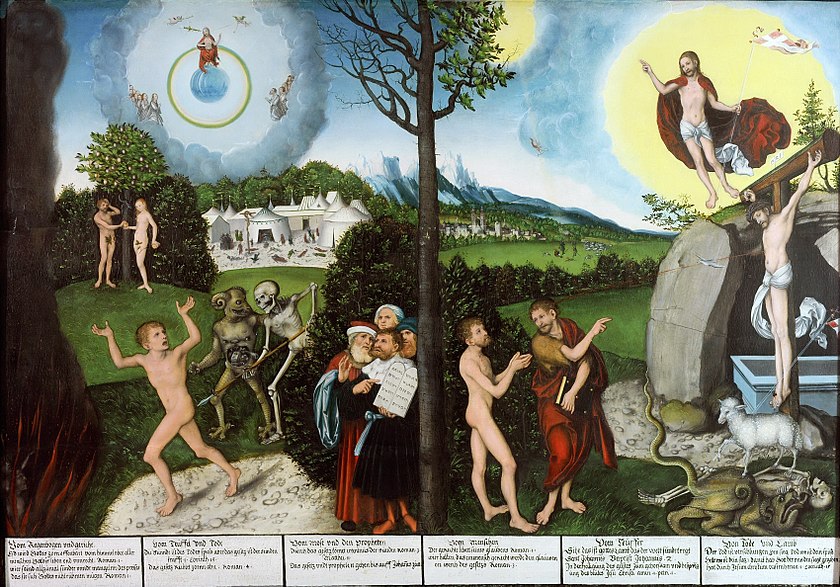
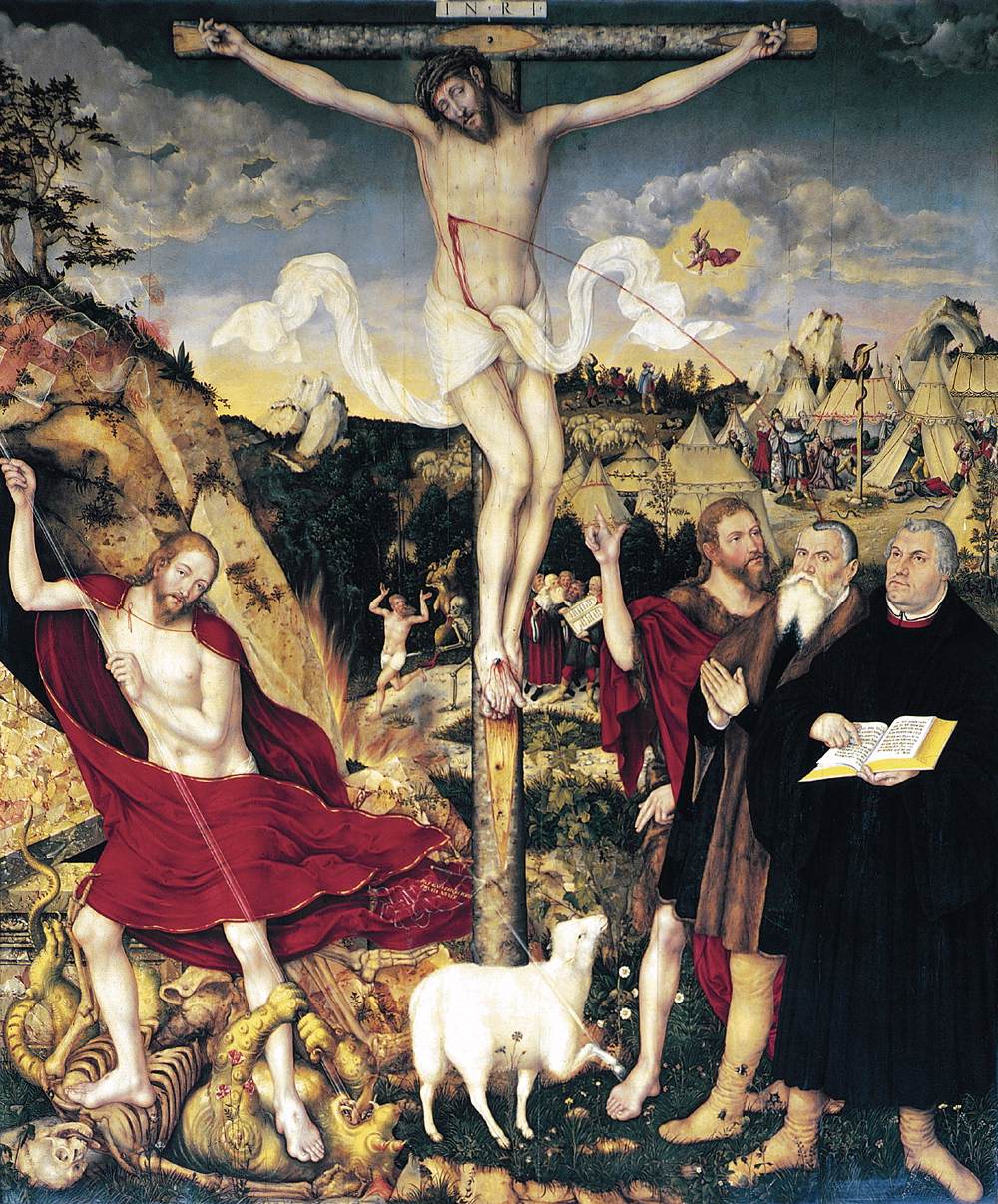
A Defense of Beauty: Lutherans and Church Art
Early Church Architecture
The earliest Lutheran churches took a variety of forms, yet all display a commitment to the gathering, the centrality of Sacramental life — Holy Baptism and the Lord’s Supper — and the authority of Scripture.
About Redeemer’s Organ
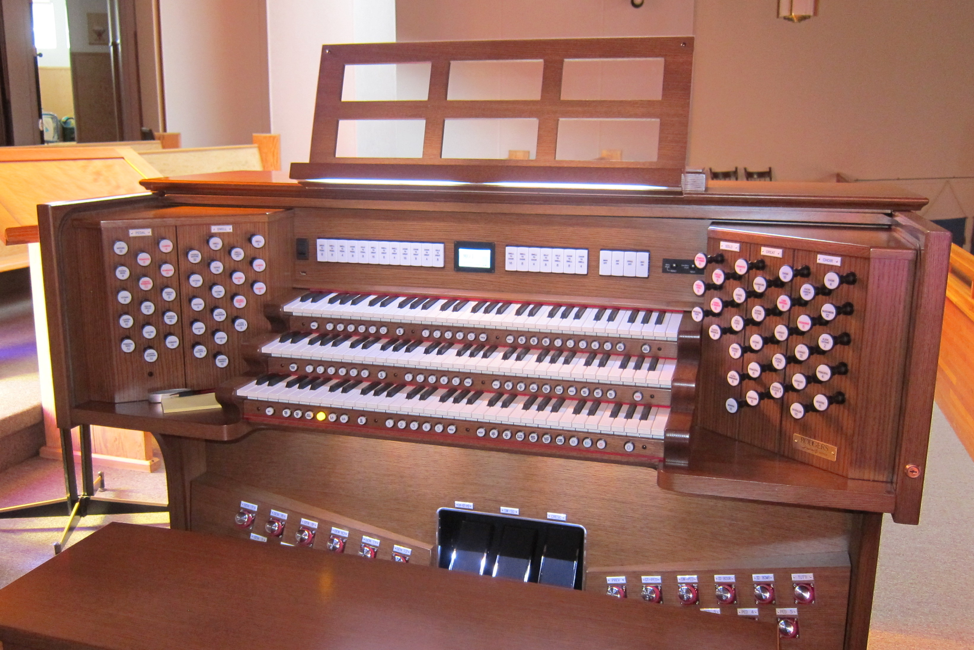
The organ at Redeemer was built by Rodgers Instruments Corporation of Hillsboro, Oregon and installed in 2013. The Infinity Model 361 spans various tonal genres that provide extraordinary musical expressiveness and versatility. A phalanx of 12 speakers (including four subwoofers) is installed in the sanctuary that work together to produce dimensional sound along the same paths that would be followed by natural pipe organ sounds. There are three manuals with a significant stop selection augmented with hundreds of additional stop library voices. It is possible to perform various periods and style of organ repertoire with accurate authenticity using this model of organ.
Specifications
– 3 Manuals (Drawknob Console)
– 59 Primary Stops (Can be augmented to a total of 376 voices)
– Chimes and Zimbelstern
– 19 Couplers; 8 MIDI Controls
– 25 Divisional Pistons; 12 General Pistons; 24 Configurable Toe Pistons
– 99 Levels of Memory per Piston
– 2 Expression Shoes; 1 Crescendo Shoe
– 4 Main Tremulants
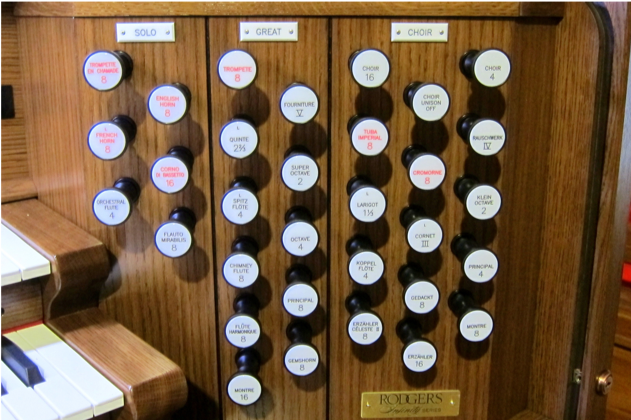
Organ Disposition (Engraved Stops)
GREAT (Manual II) SWELL (Manual III)
Montre 16′ Bourdon Amabile 16′
Principal 8′ Diapason 8′
Harmonic Flute 8′ Bourdon 8′
Chimney Flute 8′ Flute Celeste 8′
Gemshorn 8′ Viole Celeste 8′
Octave 4′ Prestant 4′
Spitzflöte 4′ Traverse Flute 4′
Quinte 2 2/3′ Nazard 2 2/3′
Superoctave 2′ Octavin 2′
Fourniture V 1 1/3′ Tierce 1 3/5′
Trompete 8′ Chorus Mixture IV
Double Trumpet 16′
Trumpet 8′
Hautbois 8′
Clarion 4′
CHOIR (Manual I) PEDAL
Erzähler 16′ Principal Bass 32′
Montre 8′ Contra Bourdon 32′
Gedeckt 8′ Contra Bass 16′
Erzähler Celeste 8′ Subbass 16′
Principal 4′ Bourdon Amabile 16′
Koppelflöte 4′ Violone 16′
Cornet III Octave 8′
Klein Octave 2′ Violoncello 8′
Larigot 1 1/3′ Gedackt Bass 8′
Rauschwerke IV Choral Bass 4′
Cromorne 8′ Mixture IV 2 2/3′
Tuba Imperial 8′ Contra Bombarde 32′
Bombarde 16′
Trompete 8′
Clarion 4′
SOLO (Floating)
Corno Di Bassetto 16′
Flauto Mirabilis 8′
Trompete/Chamade 8′
French Horn 8′
English Horn 8′
Orchestral Flute 4′